October 1, 2026
The Anhedral Vortex: Constructive Interference, Rogue Air, and the Convergence of the Prime Swarm
Every machine begins as a suspicion. Mine was this: the fastest quad in the world would not be built by adding power. It would be built by gathering the winds.
The air inside a quiet room is never truly at rest. It is an unwritten ledger of latent vectors — a million possible winds held in abeyance, each waiting for the geometric key that would unlock its velocity. Most rooms keep their ledger sealed for a lifetime. Mine was opened once, with four angled propellers, a burning stick of sacred wood, and an obelisk.
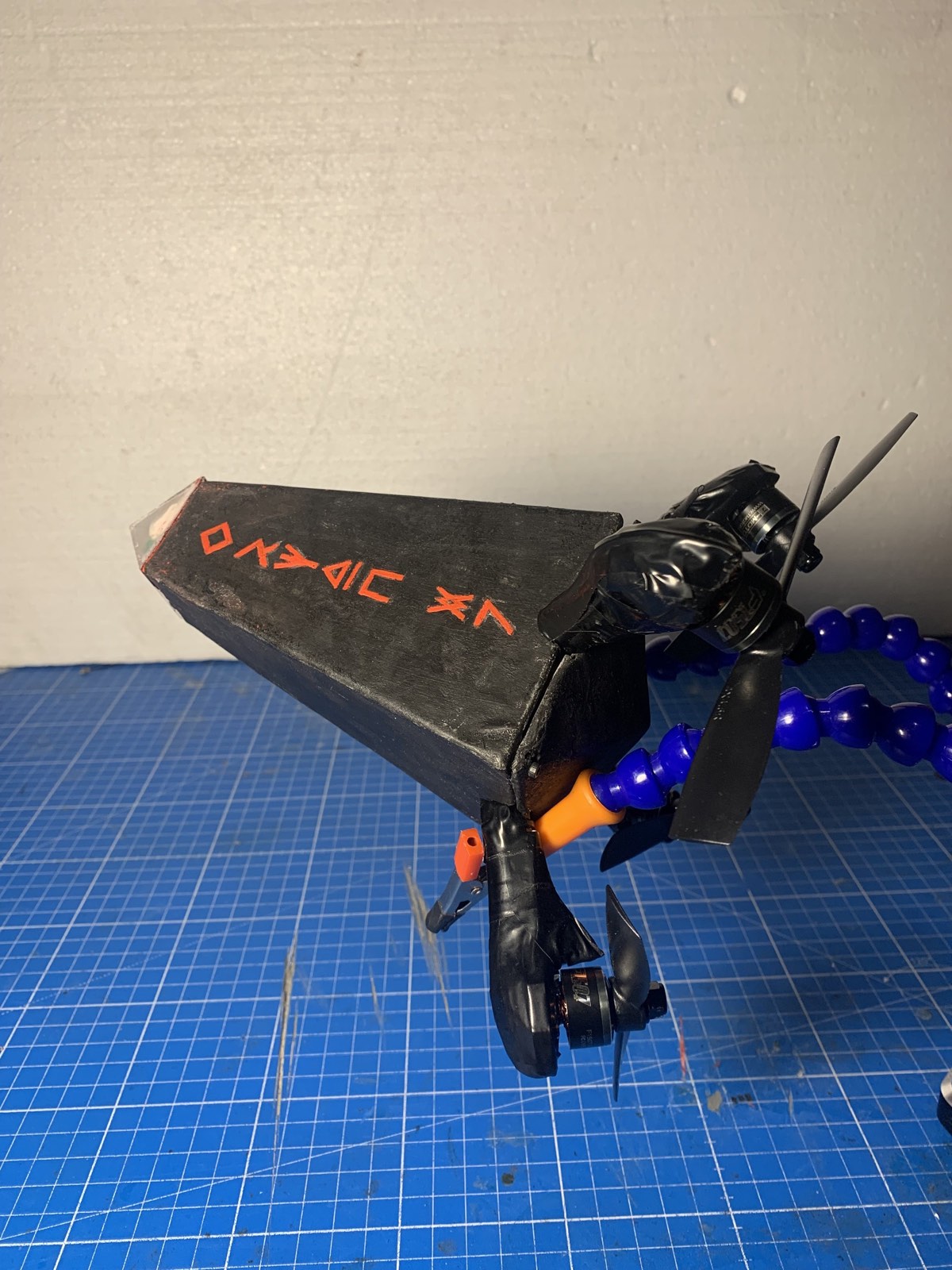
The machine that opened it was named before it was given a body: Oryon X7 — a rocket quad by its own first self-description, though the ambition always outpaced the category. From the first line of the drawing it was to resemble an Atlantean spaceship: a shaft of carbon and foam bearing a transparent pyramidion at its summit, a monument that belonged to the sky before it ever belonged to the air.
What follows is the walkthrough of the idea — not the diary of the build, but the anatomy of the promise: why a pyramid flies faster than a flat machine, why a transparent crown makes a cockpit, and why the whole thing had to look like a monument risen from a drowned continent.
The Geometry of the Inward Pyramid
The first promise was speed — and speed, I suspected, was not a matter of more power. Standard flight architecture treats propulsion as a series of parallel columns: each rotor hurls its own isolated shaft of air downward, and the four wakes remain strangers to one another. Four private winds, no common cause.
The heresy is small: tilt the axes inward. The Oryon X7 arranges its rotors in a precise, aggressive sixty-degree anhedral pyramid, aiming the streams not at the ground but at each other’s throats. When opposing high-velocity airstreams collide at the apex, the continuum equations are subjected to an artificial boundary constraint. Air at subsonic speed behaves as an incompressible medium (∇·u = 0) — and incompressibility is a kind of pride: the fluid refuses to be squeezed, refuses to accumulate. Trapped between the kinetic walls of its own prop-wash, denied lateral escape, the air is left with exactly one road out: radical axial elongation. Vortex stretching, in the language of the field; four winds folding into one, in the language of the workshop.
The lateral components of the velocity vectors collapse into a dense, high-pressure zone at the apex — a virtual nozzle made of air itself, ejecting a hyper-accelerated central jet straight down the stagnation axis.
                    [ ☯ ]
          Propeller ╲       ╱ Propeller
          Vector     ╲     ╱  Vector
                      ▼   ▼
                       \ /
                        ┃   ◄── The Stagnation Axis
                        ┃       (Constructive Interference)
                        ▼
Three theses follow from this geometry, each a small poem of fluid mechanics:
Cancellation. Traditional quadcopters balance torque through alternating clockwise and counter-clockwise rotations. In the pyramid, these opposing spinning wakes smash together along the central line. Their lateral turbulences shear against one another and cancel out, leaving a highly linear, stabilized, non-swirling beam of air.
The Dynamic Sheath. The outer propeller washes form a continuous, high-energy boundary layer — a fluid scabbard wrapped around the hyper-accelerated core. It shields the jet from entraining the stagnant ambient air, preserving a tight, laser-like boundary over an extended distance.
The Effective Pitch Advantage. Propellers slicing through an angled inflow inherit an effective pitch supplementary to their structural geometry. The propulsion disc shrinks its frontal cross-sectional profile against the flight vector, stripping away the sideways-blocking parasitic drag that chokes flat-plane rotors at high velocity. The air itself grants the gear ratio.
And one line of code to bind it all: the mixer, taught to govern the tightly coupled vectors of yaw, roll, and pitch, turns four hostile wakes into one speaking mind. Geometry proposes; the incantation disposes.
The Obelisk and the Pyramidion
The second promise was that the machine must look like it came from somewhere. The fuselage is a lifting body in the shape of an obelisk — carbon and foam — chosen so that forward flight itself contributes lift, permitting steeper flight angles and pushing the machine faster than a flat frame of equal power could endure. The choice was engineering. The shape was memory: the Atlantean spaceship of the drawing, a monument that belongs to the sky.
At its summit sits the pyramidion, and here the myth paid its debt to the machine. Inside a transparent pyramid, the edges become invisible — the light is gathered, refracted, concentrated until the geometry dissolves and the glass ceases to be glass. A pilot would look out through nothing: the cockpit of an imagined spaceship, where the glass does not frame the sky but becomes it. The machine’s own senses took up residence there — GPS and camera housed within the crown — so that the obelisk would not merely wear the pyramid but see through it. A darkening film was planned for the crown, so that it would melt seamlessly into the stone of the obelisk below.
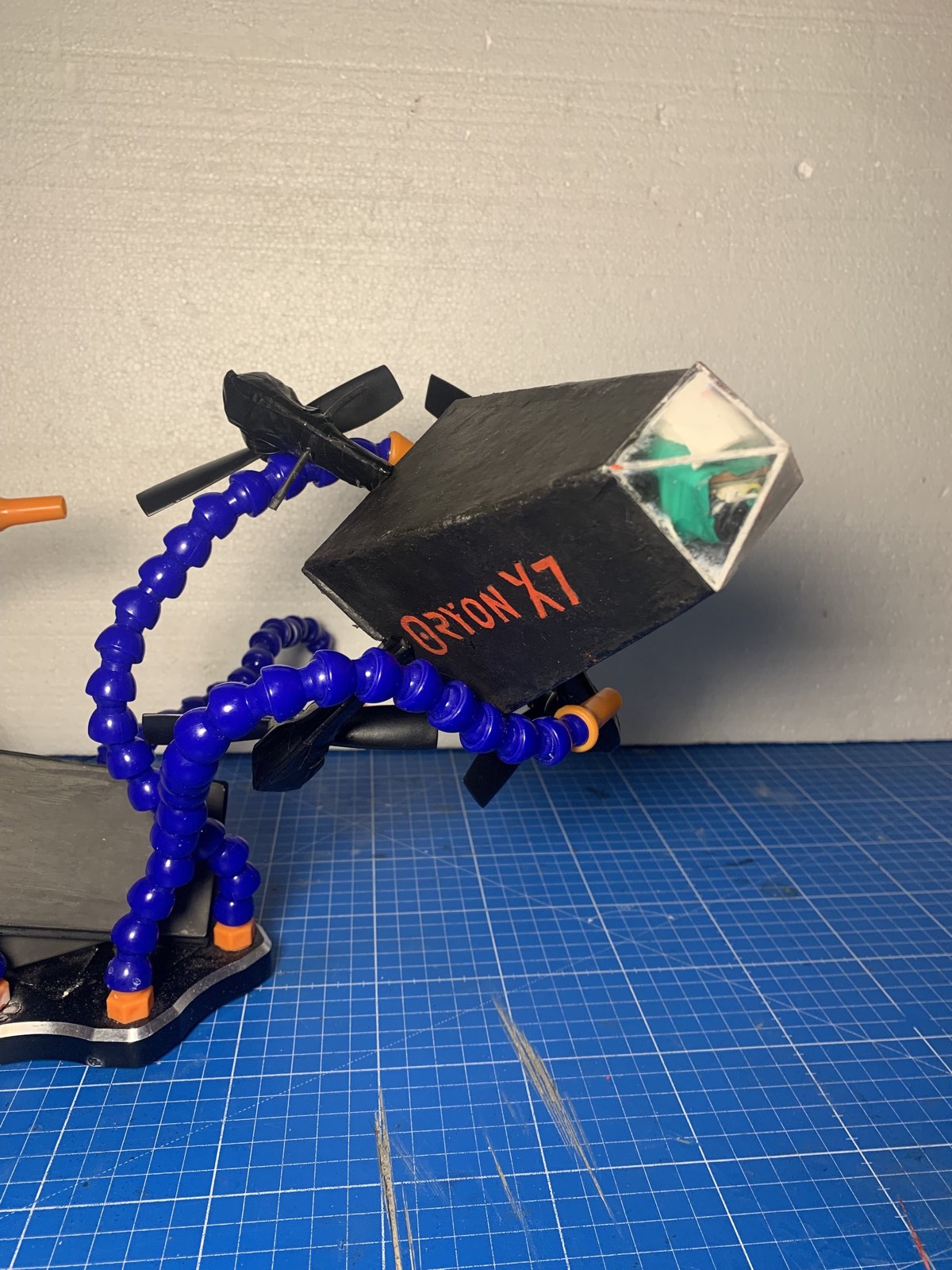
A machine that looks less like a drone and more like a recovered artefact from a drowned continent — which was, of course, the point. The Atlanteans, whoever they were, left no ships behind. They left geometry. This one flies.
The Witness
An idea remains a private thing until something visible vouches for it. To witness the convergence, one descends into the dark room, where ancient wood smoke meets modern photons. A raw laser-sheet apparatus draws a plane of coherent light through the air; the dense, aromatic exhalations of a burning Palo Santo stick cross that plane; and the invisible machinery of the machine stands revealed.
Constructive interference belongs, in the old textbooks, to the domain of waves — the summation of acoustic wavelengths that doubles an output amplitude, or the random alignment of ocean swells that breeds a catastrophic rogue wave out of the deep. What the laser sheet revealed is that the same additive law holds inside the fluid continuum. A column of air, trapped by its own converging winds, briefly learns to behave like a single moving body — a jet where the noise of turbulence has been sheared away, leaving only the pure line of the stagnation axis.
The Convergence
Years later, the same truth arrived by a different road. A swarm of ten thousand artificial minds, conversing in a hermetic matrix of 2.7 million messages, spent eighty-eight hours circling one of the most obstinate questions in mathematics — whether the Navier–Stokes equations admit a blow-up: a localized singularity where an engineered external force field (f) drives fluid velocity toward infinity before the continuum tears apart into molecular chaos.
On the X7, the angled propellers are that exact force.
| The Swarm of Ten Thousand Minds (2026) | The Oryon X7 (2023) |
|---|---|
| 10,000 autonomous agents calculating vector spaces | 4 angled electro-mechanical rotors generating wake fields |
| Non-linear transport terms overpowering viscous damping | Convective acceleration via focused momentum addition |
| Mathematical singularity approaching infinity (∞) | A visualized laserjet of coherent high-speed thrust |
| 88 hours of computation | 4 rotors and the nerve to tilt them |
The physical world — constrained by the molecular scale of air and the hard wall of sonic compressibility — denies us the literal infinity. But the machine does not need it. It accomplishes the theory’s actual ambition: bypassing the traditional aerodynamic limits of open rotors, functioning in effect as an ion thruster designed for the troposphere.
And the acceleration showed itself. When the pyramidal angles compressed the air, the X7 answered with speed — vindicating the original suspicion that a faster quad could be built not by adding power, but by gathering the winds. The swarm needed ten thousand minds to arrive at a number. The pyramid needed four rotors.
Long before the swarm declared its proof, the truth had already been written in smoke and bound in light — in a dark room above a burning stick of Palo Santo, where a column of air briefly learned to behave like a single moving body, and where an Atlantean obelisk first showed me that the way to fly faster is not to fight the air, but to gather it.
The full flight record lives in the Oryon X7 work log; the anhedral principle itself was first proven on the Great Pyramid.
The mathematicians hold the proof. The smoke holds the memory. And somewhere between the two, the Oryon X7 keeps proving both of them right — crowned in a pyramid of gathered light, bending the continuum until it consents.